Above-Ground Pool Leaf Net: Better Than a Solid Cover?
This 24-foot round above-ground pool leaf net gave me a simple way to keep leaves and bugs out while leaving the pool open to air.
Affiliate disclosure: As an Amazon Associate I earn from qualifying purchases. This article may contain affiliate links, which means I may earn a commission at no extra cost to you.
If leaves are what turn your above-ground pool into a maintenance project each winter, this above ground pool leaf net is a sensible alternative to a solid cover. I put this 24-foot round net on my own above-ground pool to keep leaves and bugs out while allowing the water to stay open to air. That was the job I needed it to do in Texas, where my main off-season concern is debris rather than sustained freezing weather.
The useful distinction is that this is a mesh debris net, not a solid pool cover. It is designed to sit across the pool, pull down around the outside edge, and cinch at the perimeter with a cable and small winch. For my pool, that combination made it a practical way to keep material out of the water without managing a heavy solid sheet every time leaves accumulated.
A practical seasonal debris cover for a 24-foot round above-ground pool. I liked the cable-and-winch fit system and the ability to leave my ladder in place, but expect to spend a little time adjusting tension around the pool.
As an Amazon Associate I earn from qualifying purchases.
| Pool setup used | 24-foot round above-ground pool |
|---|---|
| Cover type | Seasonal leaf and debris net |
| Securing method | Perimeter cable with winch |
| Edge design | Grommets around the net perimeter |
| Ladder compatibility | Can be routed around a ladder left in place |
How this above ground pool leaf net fit my pool
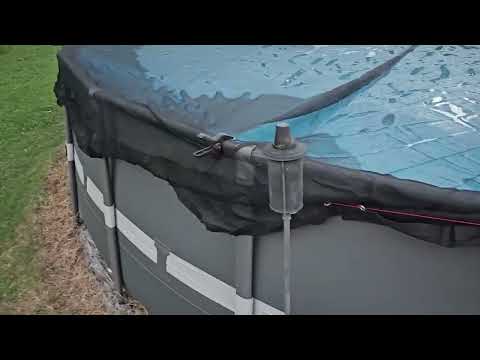
I installed the net on a 24-foot round above-ground pool. The perimeter has grommets all the way around it, and the net has enough material to pull down the sides of the pool. A wire cable goes through the grommet holes, travels around the outside of the pool, and connects to a small tensioning winch. Tightening that winch cinches the cable around the pool wall.
That perimeter system is important because it gives the net more than a loose, draped-on fit. The cable is what holds the edge in position after the net is pulled over the pool. I like that the net has a specific way to be secured rather than depending only on the weight and placement of the material around the top rail.
There was plenty of material available on my pool. I could pull it farther down in some places, and I still had room to tighten it more than I did. My installation was not as tight as it could have been, which is why some areas sat lower than others. I see that as a setup consideration rather than a reason to dismiss the net: the extra material gives you adjustment range, but you need to take advantage of that range as you work your way around the pool.
A round pool helps make the basic route straightforward, but the edge is never entirely uniform once real pool equipment is involved. In my case, I left the pool ladder installed and routed the net around it. I was not interested in taking the ladder out just to install a leaf net. The net accommodated that choice, although the ladder section naturally is not as uninterrupted as the rest of the pool perimeter.
For buyers with the same 24-foot round pool format, the fit I got is the most relevant evidence here: the net covered the pool, extended down the sides, and left enough extra material to pull tighter. I cannot say how it will fit a different diameter, shape, or pool-wall configuration, because I only used it on my 24-foot round setup.


Why I chose a leaf net instead of a solid cover
I used this net instead of putting a solid cover on the pool. That choice comes down to the problem I was trying to solve. I wanted to keep leaves from dropping into the water over winter so the water would not turn colors, and I also wanted a cover style that left the pool open to air. A leaf net addresses that specific need without sealing the entire top under a solid layer.
In my use, it did a good job keeping leaves and bugs from getting into the pool. That is the central product benefit. Every leaf or bug stopped at the net is something I do not have to retrieve from the water later. For a pool owner dealing with seasonal debris, that can make off-season upkeep feel much less like a cleanup project waiting to happen.
The other advantage is the cleanup approach. I can use a leaf blower to blow surface debris off the net. That is more appealing to me than handling a solid cover loaded with dry leaves. The practical lesson is to clear debris before it becomes wet, packed down, or harder to move. I am not claiming that every type of debris will clear the same way in every condition, but surface leaves were the debris I had in mind with this setup.
Leaving the water open to air is not an incidental feature; it is the reason this category can be a better match than a solid cover for some owners. If your priority is basic leaf and bug control, a mesh net offers a focused solution. It is not trying to be every kind of pool cover at once.
That also means it should be selected for the correct task. I would not choose a leaf net when I needed a cover intended for safety, snow load, standing water, or severe-freeze protection. I did not test it in high winds, heavy rain, snow, prolonged freezing weather, or as a weight-bearing cover, so I cannot make claims about those conditions. For my mild Texas winter use, debris management was the priority, and that is where this net made sense.
How the cable, grommets, and winch affect setup
The grommets, cable, and winch are the functional parts of the installation. The grommets provide the route for the wire cable around the edge. Once the cable has been routed through them and around the pool, the small winch is used to tighten the perimeter. That lets the net draw in around the outside instead of merely sitting over the water.
I found the system understandable because each part has a clear role: the net covers the pool, the grommets guide the cable, and the winch provides the tightening point. Still, a good final fit is not automatic. I had areas that were looser than others, and I knew I could tighten the net further. Anyone considering this style should expect to spend a few extra minutes looking around the full perimeter rather than treating the first pass as the final position.
Extra material is helpful because it gives you room to make those adjustments. On my pool, the net could be pulled lower and tighter in places. But extra material does not erase the need to position the net carefully around obstacles. The ladder is the clearest example: it was convenient to leave it in place, but routing around it required a little more hands-on positioning than a clear, uninterrupted edge would require.
If you want more angle across the top, I mentioned that a winter pillow underneath could create an angled shape. That could make surface debris easier to move off. I did not use that setup, so I cannot say how much slope it would create or whether a pillow is included. I simply see it as an optional approach for someone who wants a less-flat net surface.
My advice is to view tension as part of ownership, not a one-time detail. The cable-and-winch system provides the means to cinch the net, but the final result reflects how tightly and evenly you choose to set it. On my pool, I had the material and adjustment room to improve the tension further if I wanted to.
+ Pros
- Helped keep leaves and bugs out of my 24-foot round pool.
- Cable-and-winch system cinches the perimeter around the pool.
- Extra material provided room to adjust the fit tighter.
- Can be routed around an installed pool ladder.
- Surface leaves can be blown off with a leaf blower.
− Cons
- Fit can be loose in some areas until the cable and net are adjusted carefully.
- Routing around an installed ladder interrupts the otherwise continuous perimeter fit.
Who this seasonal pool net suits best
I would recommend this above ground pool leaf net to owners of 24-foot round pools who want to reduce seasonal leaf and bug cleanup. It is especially relevant if the alternative you are considering is a solid cover and you prefer a mesh layer that leaves the pool open to air.
It is also a good match for someone who wants to leave an above-ground pool ladder installed. I did exactly that and routed the net around it. The ladder area is a fit compromise, but it saved me from removing the ladder for this seasonal task. If keeping the perimeter completely uninterrupted matters more than ladder convenience, removing the ladder may offer a cleaner edge; I chose convenience instead.
My use case is mild-winter pool care in Texas. We do not really freeze for more than a short period, so I was not shopping for serious freeze protection. I wanted to keep leaves out of the water and avoid dealing with a solid cover. Pool owners in a similar climate, or owners whose primary concern is debris, are the clearest audience for this product.
This net may be less suitable if you need verified long-term durability information, protection in severe weather, compatibility confirmation for another pool size or shape, or a safety-rated cover. I did not establish those things in my use. The same applies to the mesh, grommets, cable, and winch over multiple seasons: I can describe what I installed and how it worked for debris control, but not make a long-term durability promise.
Buyer considerations before choosing a leaf net
Start with the purpose. A leaf net is for leaves, bugs, and similar surface debris. It is not the same product category as a solid winter cover. If that limited, focused role is what you need, the open-to-air design is an advantage. If you need a cover for another duty, choose based on that requirement rather than assuming every pool cover performs the same job.
Next, compare your pool to the setup I used. My firsthand fit observation is for a 24-foot round above-ground pool only. I had material extending down the sides and extra material to pull tighter. I do not have a confirmed fit result for pools with different diameters, shapes, or features.
Then consider obstructions around your pool. Leaving a ladder in place worked for me, but it changed how the net met the edge in that location. This is not necessarily a deal-breaker; it is simply worth anticipating before you start. A pool edge with nothing in the way should be simpler to route around than one with a ladder that stays installed.
Finally, plan around cleanup. One reason I prefer this style for my situation is that leaves on the surface can be blown off with a leaf blower. It makes sense to remove debris while it is still manageable instead of letting it sit and build up. That simple maintenance routine complements the main reason for using the net in the first place: keeping the water cleaner between seasons.
Specs
| Spec | Detail |
|---|---|
| Product type | Above-ground pool leaf net |
| Pool shape used | Round |
| Pool size used | 24 feet |
| Perimeter hardware | Grommets for cable routing |
| Tensioning hardware | Wire cable and small winch |
| Coverage fit | Material extends down pool sides with adjustment room |
Scorecard
Kept leaves and bugs out in my pool setup.
Cable and winch provide a useful cinching system.
Extra material helps, but tension takes some setup work.
Works around an installed ladder with some fit compromise.
A practical alternative to a solid cover for leaf cleanup.
My final take on this 24-foot pool leaf net
For my 24-foot round above-ground pool, this net was a simple and effective seasonal debris solution. The grommets, wire cable, and small winch gave it a real perimeter-securing system, while the extra material let me pull the net down around the sides and adjust it further. It helped keep leaves and bugs out while allowing the pool to remain open to air.
The two practical caveats are also straightforward. My net was looser in some spots because I had not tightened it as much as I could have, and the ladder required me to route around it. Neither issue outweighed the benefit for my use, but both are good reasons to take your time with the fit.
If your goal is seasonal leaf control on a 24-foot round above-ground pool—not snow support, safety coverage, or severe-freeze protection—this is the kind of cover I would choose. It targets the actual mess I wanted to avoid, and it gives me a simpler path for clearing leaves off the top than a solid cover.
FAQ
Will this leaf net fit a 24-foot round above-ground pool?
It fit my 24-foot round above-ground pool. The material extended down the sides, and I had additional material available to pull tighter. My experience is limited to that pool size and round shape.
How does the net stay on the pool?
A wire cable routes through grommets around the net perimeter. A small winch tightens the cable around the pool, cinching the net at the edge.
Can I leave my above-ground pool ladder in place?
I did. I routed the net around my installed ladder rather than removing it. That area took extra positioning and did not have the same uninterrupted fit as the rest of the edge.
Can I use a leaf blower on the net?
Yes, I found that surface leaves could be blown off the net with a leaf blower. Clearing dry debris before it accumulates is the practical approach I would use.
Is a leaf net the same as a solid winter pool cover?
No. This is a mesh net for keeping leaves, bugs, and similar debris out while leaving the pool open to air. I would select it for debris control, not assume it provides safety, snow-load, standing-water, or severe-freeze protection.
As an Amazon Associate I earn from qualifying purchases.